

How to Choose the Best Bookkeeping Service in Birmingham
August 22, 2026
Tax and self assessment explained for owner-managed businesses: common mistakes and how to avoid them
September 16, 2026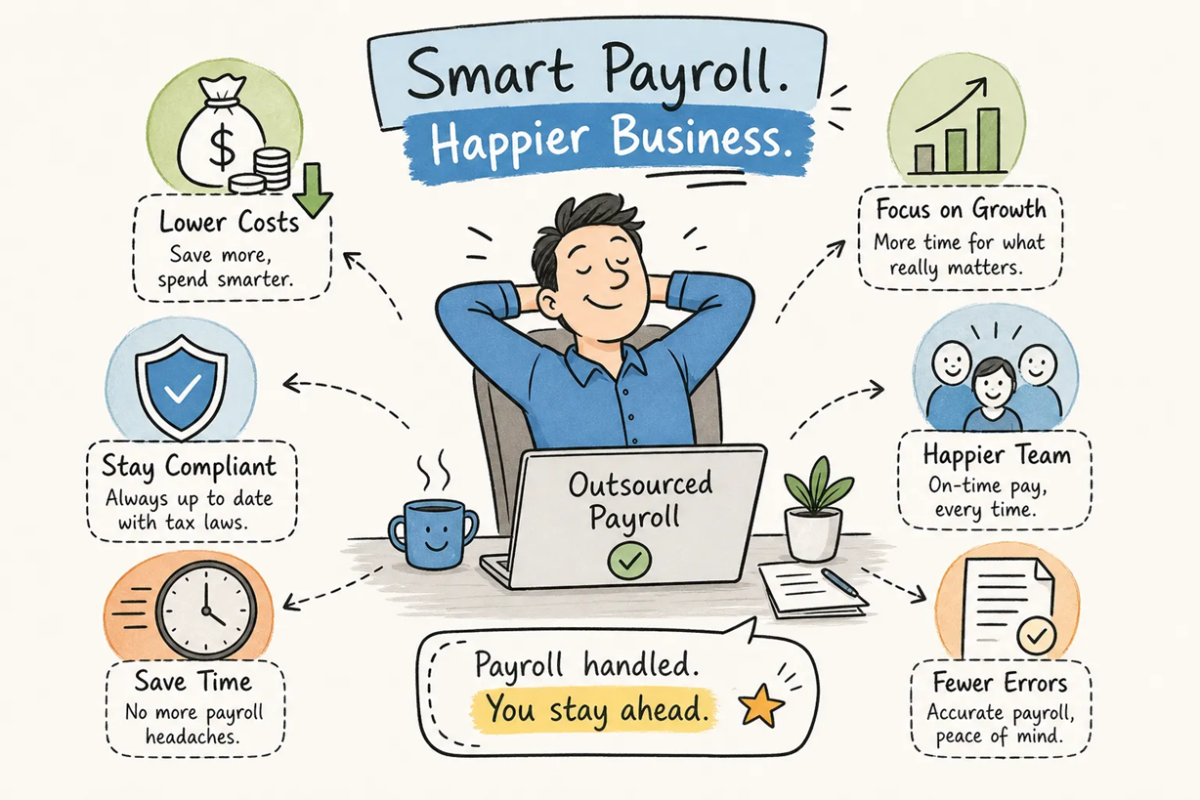
Table of Contents
Payroll looks simple until it isn’t. You’re staring at an RTI deadline you nearly missed, a payslip that went out with the wrong tax code, or a pension contribution that wasn’t uploaded on time. None of these are dramatic failures; they’re the ordinary friction that comes from treating payroll as an afterthought rather than a system. Most UK SME owners patch problems as they arise rather than building something reliable. At Smurz, we find that many owner-managed businesses underestimate what compliant payroll processing genuinely demands every single month, and that’s precisely where professional payroll services UK SMEs make the biggest difference.
This article covers what your options actually are, what the compliance obligations underneath payroll require, what managed payroll costs in 2026, and the specific benefits that make outsourcing the right call for most small businesses. By the end, you’ll have enough to shortlist providers, understand what features to demand, and ask the right questions before signing anything.
What UK payroll compliance actually demands from you
Most business owners know they need to run payroll. Few understand the full regulatory load sitting underneath it. Getting clarity on this upfront is the only way to make an informed decision about how you handle it.
PAYE, RTI and the deadlines that don’t move
PAYE is your legal obligation as an employer to deduct income tax and National Insurance from employee wages before they’re paid. That part most people grasp. What catches businesses out is RTI: the requirement to submit a Full Payment Submission to HMRC on or before every single payday, not monthly, not quarterly. Every payday. A business with 10 employees that misses three RTI filings in a year faces automatic penalties of £200 per late submission before HMRC has even considered whether the non-compliance was deliberate. The penalties scale with headcount: 1 to 9 employees costs £100 per late filing, 10 to 49 employees costs £200, and it climbs from there. HMRC does allow one late filing per year if the return is no more than three days late, but that grace note disappears quickly if lateness becomes a pattern.
Auto-enrolment and CIS: the layers most SMEs overlook
Auto-enrolment adds another compliance duty that sits alongside PAYE. You’re legally required to enrol eligible workers into a qualifying workplace pension scheme and make minimum employer contributions. In 2026/27, that means at least 3% from the employer and 5% from the employee (including tax relief), on qualifying earnings between £6,240 and £50,270 per year. Re-enrolment happens every three years, regardless of whether your workforce has changed. For construction businesses using subcontractors, there’s a further layer: the Construction Industry Scheme requires you to verify each subcontractor with HMRC, deduct tax at 20% or 30% depending on their verification status (or 0% for subcontractors who hold gross payment status, per HMRC CIS guidance), file a monthly CIS return by the 19th of the following tax month, and issue payment and deduction statements within 14 days of the tax month end. Auto-enrolment and CIS are common sources of complexity and error for small business payrolls, and where inadequate arrangements tend to unravel first.
Payroll services UK SMEs: your three main options
Once the compliance picture is clear, the decision framework becomes simpler. There are three routes, each with a genuinely different risk and cost profile.
In-house processing and payroll software
Running payroll in-house means someone inside your business, often the owner or an admin, processes each pay cycle using HMRC-recognised payroll software such as Xero, BrightPay, Sage, or Employment Hero. That actually involves data entry, gross-to-net calculations, RTI submissions, payslip distribution, pension uploads, year-end P60s, and fielding any HMRC correspondence that follows. Software subscriptions typically run £20 to £100 per month depending on headcount and features, though costs vary by vendor. The trade-off is straightforward: lower direct cost, but your business owns the compliance risk, the learning curve, and the three to five hours per pay cycle it takes to run the process properly.
Outsourced managed payroll bureaux
A managed payroll bureau handles the entire process on your behalf. You submit employee data; they run the calculations, file RTI returns, manage pension uploads, produce payslips, and flag any compliance issues before they become penalties. Pricing for managed payroll services UK in 2026 typically runs £4 to £12 per employee per month, with most micro-businesses paying a fixed minimum of £25 to £60 per month. The critical distinction from software is that the compliance burden transfers to the provider. A genuine managed service is not a software subscription with a support line attached: it’s a team running your payroll on your behalf and taking responsibility for the output.
An in-house payroll employee
Some businesses reach a size, typically 30 to 50 employees or above, where hiring a dedicated payroll administrator starts to make commercial sense. This option gives you full internal control and immediate access to someone who knows your business intimately. The cost, however, is substantial: salary, employer National Insurance, pension contributions, annual leave, and training all add up. For most SMEs, this option costs significantly more than outsourcing and introduces the same compliance risk as DIY software if the employee leaves or falls behind on regulatory changes. It’s worth costing out if your payroll is genuinely complex, but for most owner-managed businesses, it’s the most expensive route.
The top 6 benefits of outsourcing your payroll
1. Accuracy that eliminates penalty risk
HMRC penalties for incorrect submissions, underpayments, and late filings accumulate fast. Established managed payroll bureaux typically target high accuracy rates on payslip calculations, market benchmarks generally range from 98% upwards depending on the provider, with error-checking built into every submission before it reaches HMRC. That’s not just a performance metric: it’s the difference between a compliant business and one that’s quietly accruing penalties it hasn’t noticed yet. When evaluating providers, ask specifically for their contractual accuracy commitment and what remedy applies if they fall short.
2. Compliance that keeps pace with legislation
HMRC updates tax codes, thresholds, and pension minimums regularly throughout the tax year. An outsourced provider absorbs every legislative change automatically: your business doesn’t need to monitor HMRC announcements, update software settings, or hope that your payroll admin noticed the new rates. This is the compliance benefit that software alone can’t replicate, because software still requires a human inside your business to apply changes correctly.
3. Time saved every pay cycle
Businesses running payroll in-house typically spend three to five hours per pay cycle on data entry, checking, submissions, and HMRC correspondence. A managed bureau reduces that to submitting a data file and approving the output, often under an hour. For owner-managed businesses where the owner is running payroll between everything else, that time saving is not trivial.
4. Real cost savings versus in-house admin
Software subscriptions look cheaper at invoice level. They often aren’t on a fully loaded basis. When you price in internal staff time at a realistic hourly rate, the occasional penalty from a missed deadline, and the cost of error correction, the true cost of in-house payroll frequently exceeds managed payroll fees for businesses with under 50 employees. Hiring even a part-time payroll administrator costs more than outsourcing for most SMEs at this size. It’s the calculation most owners skip before concluding that software is the cheaper option.
5. Integration with your bookkeeping and VAT
When payroll data feeds directly into your bookkeeping and management accounts, month-end reconciliation becomes faster and more accurate. Businesses that fragment their financial operations across different providers introduce data discrepancies that someone has to find and fix. A single provider handling payroll, bookkeeping, and VAT returns removes most of that friction. The integration benefit compounds over time: clean data in means clean reports out, and clean reports mean better decisions.
6. Scalability as your team grows
A managed service handles one new starter or twenty without your business needing to upgrade software, retrain staff, or restructure internal processes. For SMEs in growth phases, or those with seasonal headcount changes, this scalability removes a category of operational complexity that would otherwise require ongoing attention. You add employees; the bureau handles the rest.
Payroll services UK: what managed payroll actually costs in 2026
The commercial decision needs real numbers behind it. Here’s what the market looks like for managed payroll in 2026.
Pricing models and typical ranges by business size
The most common model is per employee per month, typically at £4 to £12. Alternatives include per payslip or payroll run (£1.50 to £5 per payslip), and a fixed monthly fee with a minimum charge (£25 to £60 for micro-businesses). In practical terms: a 5-person business typically pays £20 to £60 per month; a 20-person business pays £80 to £150 per month; a 50-person business usually pays £200 to £400 per month. Add-ons such as CIS administration, P11D preparation, or multiple pay frequencies increase the base cost, so always confirm what’s included in the quoted fee before comparing providers.
The true cost comparison: software versus outsourced bureau
The honest calculation most businesses skip is total cost of ownership, not the subscription price. Software looks cheaper until you count internal staff time at a realistic hourly rate, typically three to five hours per pay cycle. Add training costs when software is updated or staff change, the risk exposure from penalties on missed or incorrect submissions, and the time cost of error correction when something goes wrong. For businesses with any degree of complexity, variable hours, CIS requirements, or multiple pay frequencies, the fully-loaded cost of in-house software frequently exceeds the fee for a managed bureau. This isn’t an abstract argument: it’s a calculation every owner should run with their own numbers before deciding.
How Smurz manages payroll end-to-end for owner-managed businesses
Smurz’s managed payroll services uk covers the full process: payroll calculations, RTI submissions, payslip distribution, pension upload management, and ongoing compliance monitoring. Nothing is delegated back to the client to handle. Because Smurz also provides bookkeeping and VAT returns, payroll data feeds directly into each client’s management accounts and VAT workings without manual transfer or a separate reconciliation exercise. That integration removes one of the most common sources of month-end delays and data errors in owner-managed businesses.
To illustrate the time impact: an owner-managed business with eight employees that was spending four hours per month running payroll internally, managing pension uploads separately and handling HMRC correspondence on top, could reasonably expect to reduce their monthly involvement to well under an hour by moving to a fully managed service. Smurz’s qualified team monitors RTI deadlines, pension re-enrolment dates, and HMRC code changes as standard. Clients aren’t relying on software alerts or diary reminders to stay compliant. What they get back is time, certainty, and one less operational headache handled by people who know their full financial picture.
How to choose the right payroll solution: a practical checklist
Before shortlisting any provider or committing to software, use this framework to assess your options properly.
Must-have compliance and feature criteria
Any payroll services uk provider or software solution must cover the following as standard, not as paid add-ons:
- RTI submissions included as standard, filed on or before each payday
- Auto-enrolment pension administration, including re-enrolment management
- HMRC-recognised software or bureau status
- Digital payslip distribution and employee self-service access
- P60 and P11D production at year-end
- CIS payroll capability if your business uses subcontractors
- Secure cloud-based record storage for a minimum of three years (HMRC’s minimum requirement for most payroll records), with six years recommended for NMW and auto-enrolment records
Note that some providers bundle certain items as paid add-ons. Always confirm the contract scope in writing before signing.
Questions to ask any provider before signing up
These are the questions that separate genuine managed payroll providers from software subscriptions with a support line. Ask every vendor on your shortlist before committing:
- What is your accuracy commitment, and what remedy or service credit applies if you make an error? (Request the contractual service schedule, not just a verbal assurance.)
- Who handles my RTI submissions, and what is the filing turnaround?
- Does your fee include auto-enrolment administration, or is that an add-on?
- What is your support model when I have an urgent payroll query?
- Can your service connect with my existing accounting or bookkeeping software?
- Are there setup fees and minimum contract terms?
Any provider worth working with should answer all of these clearly and in writing before a contract is signed. If the answers are vague or you’re pushed towards a sales call to get specifics, treat that as useful information about how the relationship will work once you’re a client.
The bottom line on payroll services UK SMEs
Payroll services uk is not an admin task. It is a legal obligation with real financial consequences for getting it wrong. The reassuring reality for UK SMEs is that outsourced payroll services UK are more accessible and affordable than most owners assume, and the benefits extend well beyond keeping HMRC happy. Done properly, outsourcing saves time, reduces risk, and integrates cleanly with the rest of your financial operations rather than operating as an isolated monthly exercise.
For owner-managed businesses looking for a full-service approach, Smurz handles payroll as part of an end-to-end accounting service alongside bookkeeping, VAT returns, and management accounts, so nothing operates in isolation. If you want a clear picture of what payroll services UK for your business would cost and save specifically, the straightforward next step is a conversation with the team. Get in touch for a tailored quote.
