
Top 6 benefits of outsourced payroll for SMEs — cut costs, stay compliant and save time
August 26, 2026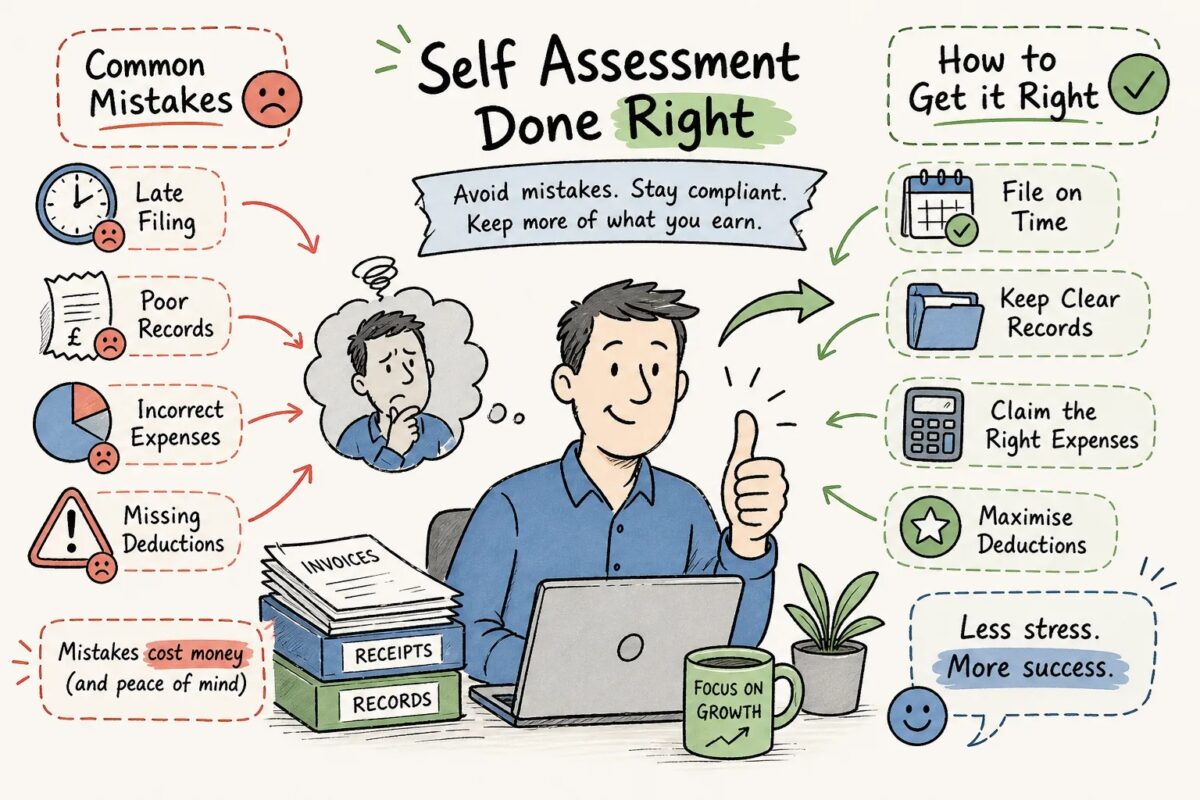
Table of Contents
If tax and self assessment are already causing you stress, you’re not alone. Most owner-managed business owners and company directors only think about their return when a deadline is looming, and that’s precisely when mistakes happen. At Smurz, we work regularly with directors, sole traders, and growing SMEs, and the same avoidable errors surface again and again: missed registration deadlines, overclaimed expenses, dividend income left off the return entirely, and allowances quietly ignored.
This article cuts through the confusion. It covers who must file a self-assessment tax return, what records HMRC expects you to have ready, the deadlines that carry real financial consequences, and the straightforward steps you can take to reduce your tax bill before you submit. If you’ve been filing your own return and aren’t fully confident everything is correct, read this before you click submit.
Tax and self assessment: who actually needs to file
The income types that trigger a filing requirement
The general rule is simple: if your income isn’t fully taxed at source, HMRC expects you to report it yourself. The main categories that trigger a self-assessment tax return include:
- Self-employed sole trader income above £1,000 before expenses
- Income from a business partnership
- Untaxed savings interest
- Dividend income
- Rental income
- Capital gains from asset disposals
- Foreign income
The High Income Child Benefit Charge also brings many people into self assessment who wouldn’t otherwise expect it. A practical way to frame it: if money landed in your account and nobody deducted tax from it first, you need to tell HMRC about it. The filing threshold isn’t always obvious, particularly when several smaller income streams combine to push you over the relevant limits.
Director-specific situations many people overlook
Company directors frequently assume that having a PAYE salary means they don’t need to bother with a self-assessment tax return. That assumption is wrong in a surprising number of cases. If you receive dividends from your company, earn income from other sources alongside your salary, or have no PAYE arrangement at all, you need to file. HMRC doesn’t always issue a notice to file, so the legal responsibility falls on the individual, not the taxman.
For 2025/26, ask yourself these questions: Did you earn self-employed or freelance income above £1,000? Did you receive dividends? Do you own rental property? Did you sell assets and make a gain? Did you earn above £50,000 and receive Child Benefit? If any answer is yes, you need to register before 5 October 2026, the deadline for new registrations for the 2025/26 tax year.
Tax and self assessment deadlines and the penalties that catch people out
Key dates for the 2025/26 tax year
There are four dates that matter for the 2025/26 tax year. First, register with HMRC by 5 October 2026 if this is your first time filing or you have a new source of income. Second, if you’re filing a paper return, it must reach HMRC by 31 October 2026. Third, online returns must be submitted by 31 January 2027. Fourth, your balancing tax payment is also due by 31 January 2027. If you make payments on account, the second instalment for the 2025/26 year falls on 31 July 2026. These dates follow standard HMRC self-assessment guidance and are confirmed on GOV.UK.
The January deadline is the one that concentrates most people’s minds. It’s worth noting, though, that the October paper deadline catches people off-guard if they leave filing late and then discover they can’t submit online for some reason.
How the penalty structure escalates quickly
Most people are vaguely aware of a £100 late filing penalty. What many don’t realise is how fast it compounds. Miss the 31 January 2027 deadline and the £100 hits immediately. Let three months pass without filing, and HMRC starts charging £10 per day for up to 90 days, adding a maximum of £900 on top. At six months, an additional penalty applies: 5% of the tax owed or £300, whichever is greater. On top of all that, late payment attracts interest at 7.75% per year on the outstanding balance (the rate that applied from 9 January 2026, though this can change in line with Bank of England movements). These figures follow HMRC’s published penalty framework, which is worth checking on GOV.UK for the latest rates. (Tax and self assessment)
To make those numbers tangible: a director who misses the January deadline by six months and owes £5,000 in tax could face £100 plus £900 in daily penalties plus a 5% charge of £250, and then interest accruing on the unpaid amount throughout. In many cases, those combined penalties can exceed typical professional fees for handling the return correctly in the first place. (Tax and self assessment)
Registering for a UTR: the step most first-timers forget
Without a Unique Taxpayer Reference (UTR), you cannot file. The UTR is issued by HMRC when you register for self assessment through GOV.UK, using your Government Gateway account. If you can’t register online, the CWF1 paper form is an alternative route. Once HMRC processes your registration, your UTR arrives by post in around 10 working days, followed by a separate activation code to unlock the online filing service. First-time filers must complete this step before they can do anything else, and the 5 October 2026 deadline applies to them just as much as to everyone else. (Tax and self assessment)
What to pull together before you start your return
Income records: what HMRC expects to see
HMRC doesn’t normally require you to submit supporting documents with your tax and self assessment (Tax and self assessment) return, but it does expect you to hold them for at least five years after the filing deadline in case of an enquiry, as confirmed in HMRC’s own record-keeping guidance. For a typical owner-managed business, that means keeping:
- Invoices and sales records for any self-employed income
- Your P60 or P45 for employment income
- Dividend vouchers
- Bank statements
- Rental income schedules
- Interest certificates
- Full disposal records for any capital gains: purchase price, sale price, acquisition and disposal fees, and dates
The distinction between “keep” and “submit” trips people up. Just because HMRC doesn’t ask for your receipts upfront doesn’t mean you can discard them. An enquiry can arrive years later, and by that point the records you didn’t keep become the evidence you can’t produce.
Expense evidence that actually holds up
On the expense side, the basic standard is straightforward: receipts, invoices, mileage logs, letting agent statements, and professional fee invoices all need to be retained. The gap between what people believe qualifies and what HMRC will actually accept is where a significant amount of tax risk lives, which the ‘Common mistakes’ section below covers in detail.
Smurz offers a preparation checklist designed specifically for owner-managed businesses and directors, covering every record category mentioned here. Get in touch via our self-assessment service page if you’d like a copy.
Common mistakes that cost owner-managed businesses real money
Expense claims HMRC frequently rejects
The same disallowed claims come up constantly. The following are regularly rejected:
- Ordinary commuting costs between home and a regular workplace, regardless of how far you travel
- Personal clothing, unless it’s a uniform or protective gear
- Client entertainment, which is specifically excluded
- Home costs claimed without a proper business-use calculation
- Gym memberships and most personal health-related costs, which don’t pass the “wholly and exclusively for the business” test
- Loan capital repayments, only qualifying interest or finance charges are deductible
What is genuinely allowable includes business travel to client sites, the business-use proportion of phone and internet costs, professional subscriptions directly related to your trade, and training courses that develop existing skills relevant to your work. The line isn’t always obvious, but it’s consistent once you understand the underlying principle HMRC applies.
Missed allowances that quietly inflate your tax bill
Just as common as overclaiming is underclaiming. Many owner-managed businesses leave money on the table by ignoring allowances that are entirely within HMRC’s rules. Some of the most frequently missed include:
- The £1,000 trading allowance, which can eliminate reporting requirements for very small side income
- Working-from-home flat-rate claims for sole traders
- Up to £6 per week tax-free from your company for directors who regularly work from home
- Capital allowances on business equipment
- Pension contribution deductions, which reduce taxable income directly
- The personal savings allowance, which allows basic-rate taxpayers to receive up to £1,000 in savings interest tax-free each year
None of these require complex planning. They just require someone to check that the return reflects everything it legitimately should.
The errors most likely to invite an HMRC enquiry
HMRC’s enquiry programme uses data-matching increasingly effectively. Omissions that once went unnoticed are now more likely to be caught. The patterns that attract attention include large unexplained changes in income year-on-year, expense ratios that look disproportionate relative to turnover, suspiciously round figures throughout the return, and omitted dividend income or capital gains. The approach to take is straightforward accuracy, not creative accounting. Getting your tax and self assessment return right costs far less than defending an enquiry.
Tax-saving moves to consider before you submit
Pension contributions as a tax-efficient lever
Contributions to a personal pension reduce your taxable income directly, and the relief works automatically for basic-rate taxpayers through relief at source. Higher-rate taxpayers need to claim the additional 20% through their self-assessment tax return, a step many people miss. If you operate through a limited company, your company’s employer pension contributions can also be structured tax-efficiently, reducing corporation tax for the business at the same time. The standard annual allowance for 2025/26 is £60,000, a ceiling most owner-managed businesses won’t approach, and unused allowance from the previous three tax years can be carried forward to increase contributions further. (Note that tapering rules apply for very high earners and that flexibly accessing a pension may reduce the allowance; check HMRC’s annual allowance guidance for your specific position.)
Dividend planning for company directors
Directors who pay themselves through a combination of salary and dividends have some flexibility in how that income is structured across the year. The dividend allowance for 2025/26 is £500, above which dividends are taxed at 8.75% in the basic-rate band and 33.75% in the higher-rate band (39.35% for additional-rate taxpayers). Staying within the basic-rate threshold, timing dividend payments across tax years, and coordinating dividends with pension contributions can each reduce overall tax liability. The key point is that this planning works best before the tax year ends, not when you’re completing the return after the fact.
Using allowances before the deadline closes
Once 5 April passes, certain opportunities disappear for that tax year. The ISA allowance, pension contribution window, and the capital gains annual exempt amount cannot be retrospectively used. If you’re reading this in the run-up to the end of the tax year, a short conversation with an accountant in February or March can identify whether there’s anything worth acting on before the window closes.
When getting professional help pays for itself
Signs your return has become more complex than a DIY job
There are situations where the risk and complexity of a self-assessment(Tax and self assessment) tax return clearly justifies professional input. Directors with mixed income streams, rental property alongside self-employment, capital gains from asset sales, overseas income, or a history of under-claiming are all scenarios where an accountant adds measurable value. Time cost matters too: many business owners spend several hours on a return that an accountant completes more accurately in a fraction of the time, often while identifying savings the owner would have missed.
How Smurz approaches self-assessment for owner-managed businesses
Smurz prepares personal Tax and self assessment for company directors and owner-managed businesses across the UK. Where relevant, we coordinate the personal return with company accounts to ensure the full picture is consistent and compliant. Our process covers allowable expense identification, dividend reporting, relief claims, and a compliance review before submission. Smurz is led by Sumaira Umair, an FCCA-qualified accountant with more than 10 years of experience working with owner-managed businesses, private equity-backed firms, and international groups.
If your return for 2025/26 feels more complicated than you’d like, or you’re simply not confident that everything is correct, reach out to the Smurz team to discuss your situation well before the January 2027 deadline. A conversation now costs nothing and can prevent a great deal of unnecessary expense later.
Getting your tax and self assessment right from the start
Knowing whether you need to file is the first step. Getting your records in order is the second. Avoiding the common mistakes covered in this article removes most of the compliance risk that causes problems for owner-managed businesses each year.
Self-assessment (Tax and self assessment) doesn’t have to be a source of stress. It just requires the right preparation and enough lead time before the deadlines arrive. If this year feels manageable on your own, use a preparation checklist and cross-check your expense claims against what HMRC actually allows before you submit. If things are getting complex, that’s exactly when a conversation with Smurz costs considerably less than the penalties or missed savings it prevents. Get your tax and self assessment (Tax and self assessment) right, and if you need support, we’re here to help.
